
Founder
Josh Wolff
ML engineer at Meta, former Uber, Stanford CS & AI grad, and serial builder. Currently building content integrity models at Meta, previously shipped GenAI-powered support systems at Uber and revenue-generating developer infrastructure serving customers in 55+ countries.
Get in touchCurrent

Meta
Building custom ML models for content integrity — detecting spam and scams across Instagram, Facebook, and Threads.
Experience

Uber
Software engineer on Conversational Experiences — designing, building, and operating GenAI-powered support systems at scale.
Contextual AI Support for Riders
Built and launched a conversational AI agent that replaced static, template-based support replies with generated, context-aware responses. Designed stateful multi-turn flows, dynamic intent mapping, and deterministic behavior tracking to keep LLM outputs controlled and explainable. Achieved over 90% accuracy, an 85% automation rate against a 70% target, and six-figure annualized cost savings.
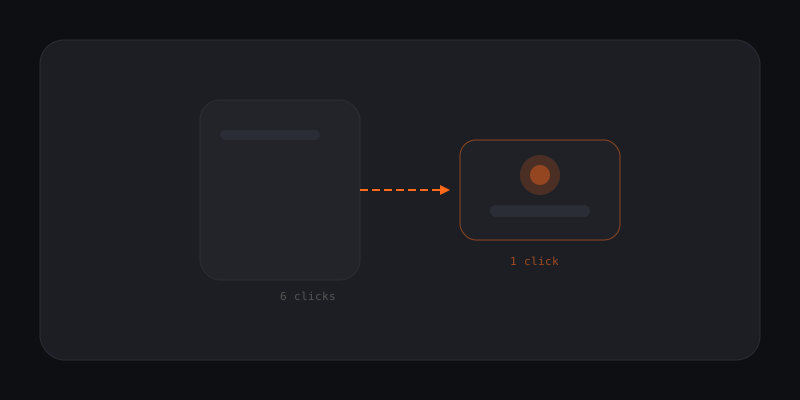
Redesigning the Support Entry Experience
Led backend integration for a redesigned help experience that reduced the path to conversational support from six clicks to one. Built orchestration logic to route increased inflow across intents and services while maintaining reliability and latency. Result: 8% increase in support inflows (fewer silent sufferers), 18% lift in automation, and a 2.5% drop in agent contact rate.
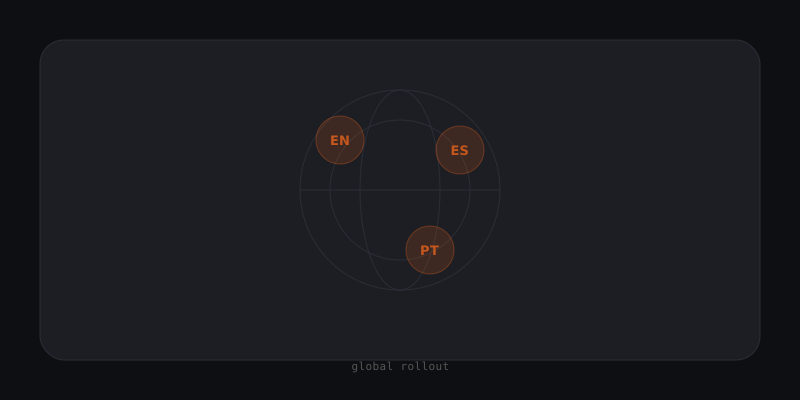
Multi-Language Business Customer Support
Led a business-support AI agent from concept through global rollout, designing multi-turn flows, agent handoff, and structured content integration. Expanded coverage to Spanish and Portuguese for Latin America. Delivered a 37% increase in customer satisfaction and handed off long-term ownership to the dedicated business support team.
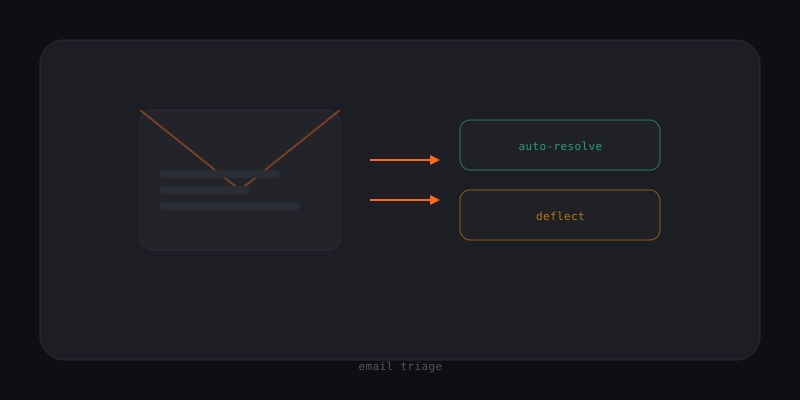
GenAI-Powered Email Triage
Designed a GenAI system to classify and deflect misrouted support emails, translating a vague cost-reduction ask into a concrete triage-and-response architecture. Drove seven-figure annualized savings and established a reusable framework for AI-driven email triage across other domains.
Platform Testing & Reliability Standards
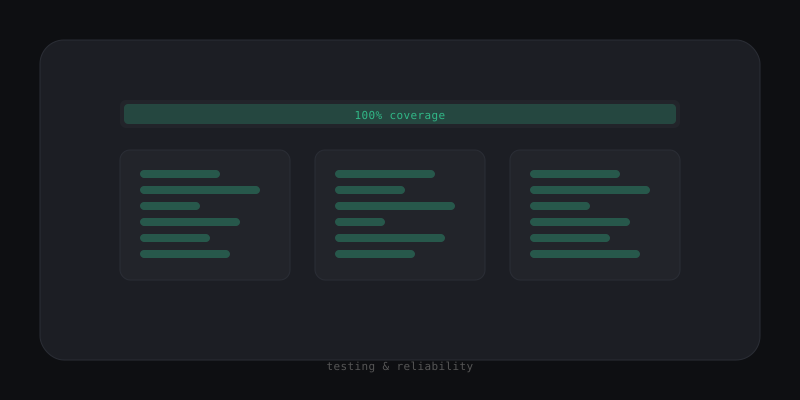
Built the first unit testing framework for the conversational AI platform's executor layer, achieving 100% coverage across 50+ components. Authored testing guides, stability runbooks, and operational dashboards adopted across teams. Led multiple incident post-mortems and drove cross-team alignment on deploy safety and observability standards.
Entrepreneurship
Ventures
Building and shipping products since 2017 — from blockchain infrastructure to AI consumer apps.
BonBonCode
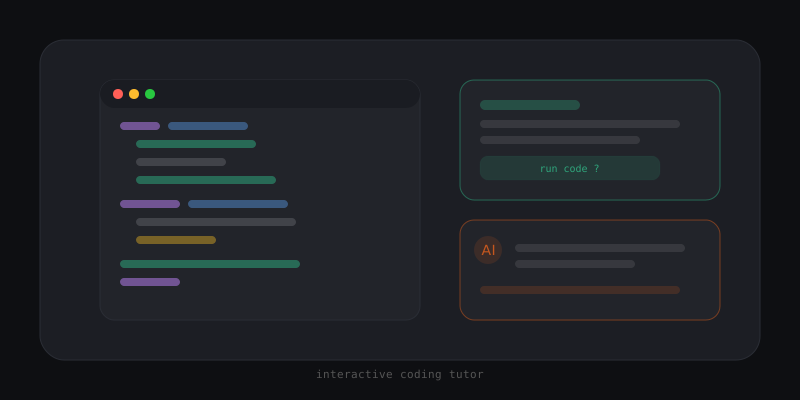
AI coding tutor that serves real, progressively challenging exercises and evaluates solutions interactively. Designed to replace passive tutorials with hands-on practice — live and free to try.
BlockchainAPI
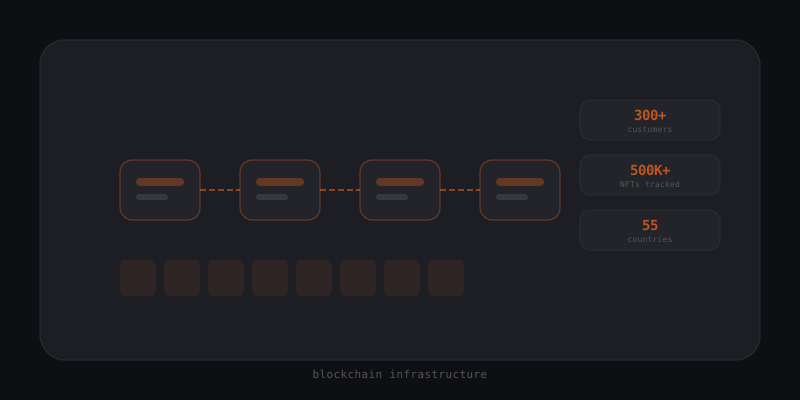
Developer infrastructure for blockchain and NFT data. Scaled to $8K/mo revenue and 300+ paying customers across 55 countries. Built real-time NFT tracking that decodes on-chain events for 500K+ NFTs — still in production today, maintained for Bonk following their acquisition of Exchange.art.
Spontit
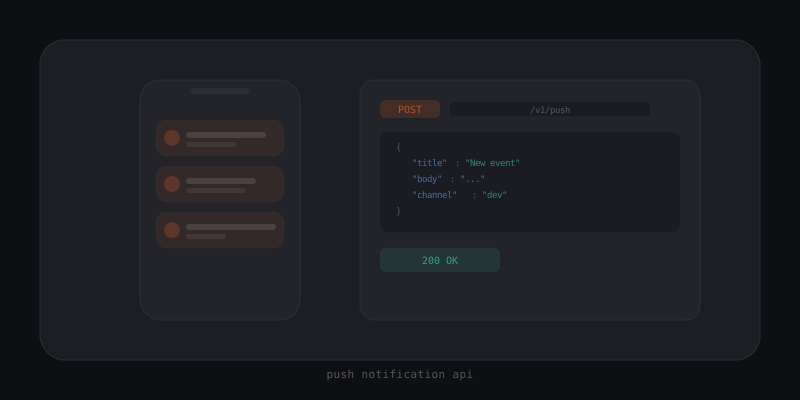
Push notification API for developers, evolved over four years from a consumer events app. Built the full stack — iOS, web, OAuth, AWS infrastructure — hired and managed a team of three, and grew to ~100 daily active developers sending notifications through the platform.
MyTarotAI
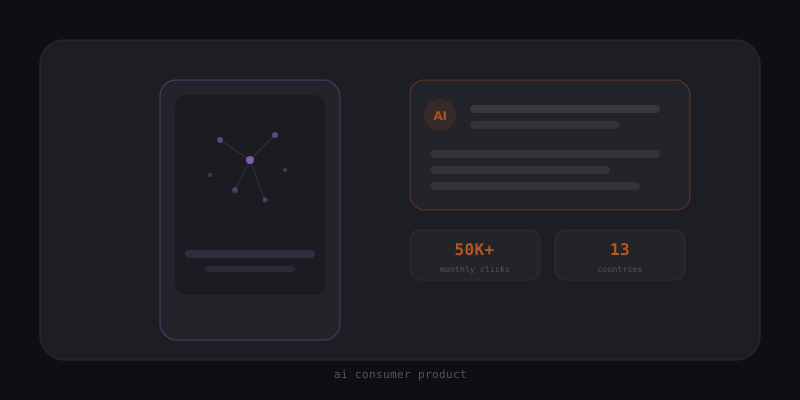
AI-powered consumer product generating 50K+ monthly organic search clicks and serving paying users across 13 countries. Built the full pipeline: content generation, payment integration, and an SEO strategy that drives consistent inbound traffic without paid ads.
AIx API
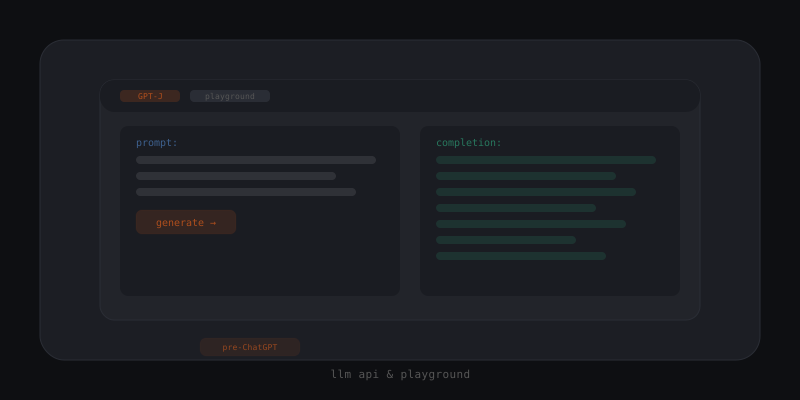
One of the first publicly available APIs and playgrounds for large language models — built on GPT-J-6B before GPT-3 access was widely available and months before ChatGPT launched. Attracted paying users and validated early demand for LLM-as-a-service.
Research
Stanford Projects
Graduate and undergraduate coursework at the intersection of machine learning and computational biology.
Predicting DNA Recombination Attachment Sites
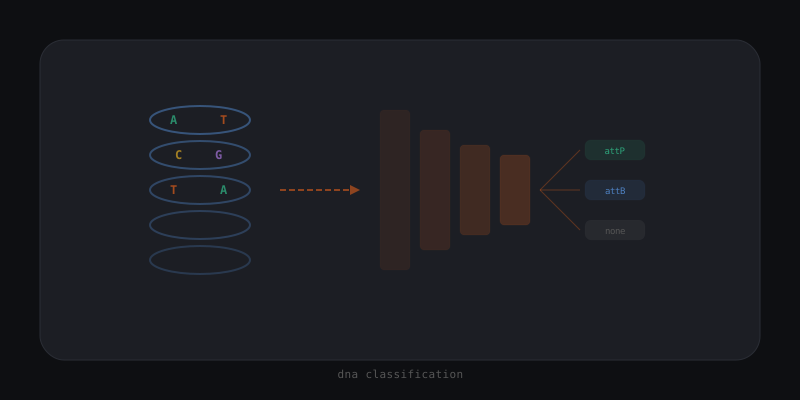
Trained and refined a convolutional neural network (CNN) to predict whether an attachment site for a recombinase was attP, attB, or neither. Input: a string of 101-150 nucleotides (ACTG).
Generating Regulatory Sequences with Cell-Type Specific Activity
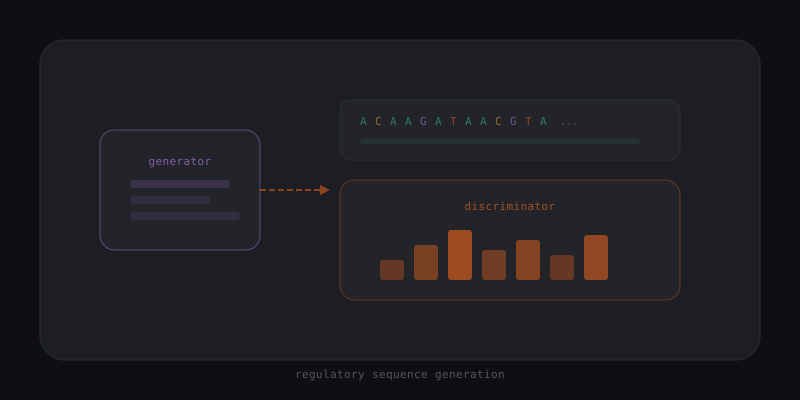
Developed models to generate regulatory sequences with cell-type specific activity. Investigated genetic algorithms, GANs, and backpropagation maximization against Google Calico's pre-trained Basenji model. Led the genetic algorithm component.
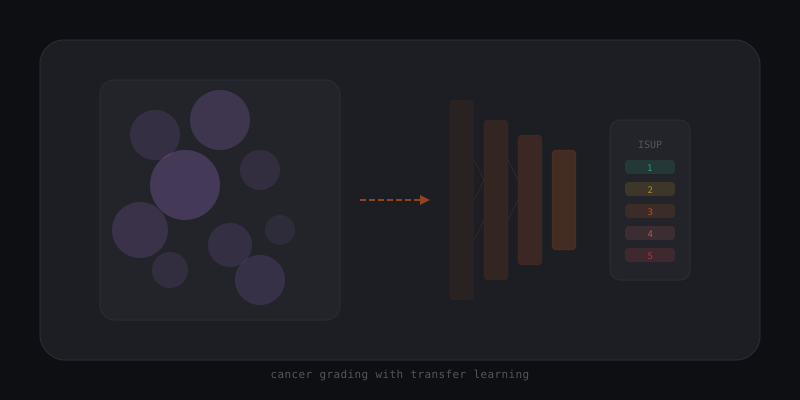
Predicting ISUP Scores on Prostate Tissue
Applied CNNs to predict ISUP scores on prostate tissue samples — a measure of cancer aggressiveness. The best-performing model used transfer learning with DenseNet-121.
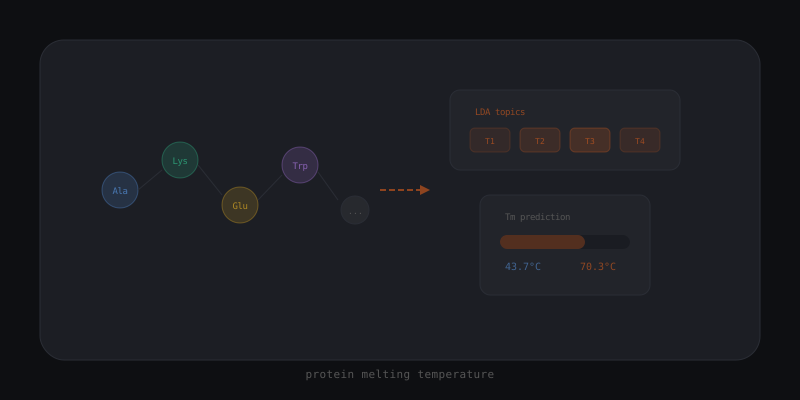
Predicting Protein Melting Temperature from Amino Acid Sequence
Applied latent Dirichlet allocation (LDA) — a novel use for this model — to extract motifs from DNA sequences, then predicted melting temperature ranges based on those extracted topics.
Education
Stanford University

Stanford University
Master of Science — Computer Science & AI
- Predicted ISUP scores on prostate tissue samples using convolutional neural networks (CNNs)
- Predicted recombinant DNA attachment sites using CNNs
- Generated regulatory genomic sequences using generative adversarial networks (GANs)
Verifiable credential
21IJ-EBL3-JAFA
Stanford University
Bachelor of Science — Bioengineering
- Genetically engineered living organisms across coursework and lab research
- Built a functional fermenter from scratch
Verifiable credential
213X-1847-JAFE
Want to work together?
Reach out directly. Every engagement starts with a real conversation.
hello@vulken.ai